How many electric trucks fit on your grid connection?
The Charging Scan combines your trips with the energy use of your building, your grid connection and the output of solar panels. For a full year, in detail. You see what electrification costs and delivers, and where the bottlenecks are. You may know it as a charging study, fleet scan, charging and infrastructure scan, depot charging feasibility study or fleet electrification assessment: it answers the same question, with your own data.
Request a Charging Scan
The questions the Charging Scan answers
How many electric trucks fit today?
Per vehicle and per trip: can it be charged at the depot, does it need a top-up on the road, or does the trip not fit (yet)? Including higher consumption in winter.
Is the grid connection large enough?
Whether it fits within your current connection, with extra time-of-use capacity or smart charging, or whether a grid upgrade is needed. And what that costs.
What does a battery deliver?
Peak shaving, charging when dynamic prices are low and storing solar power for the evening. With the investment alongside.
What do solar panels add?
How much solar power you use yourself, what you export or have to curtail, and what that means for your price per kWh.

What you get
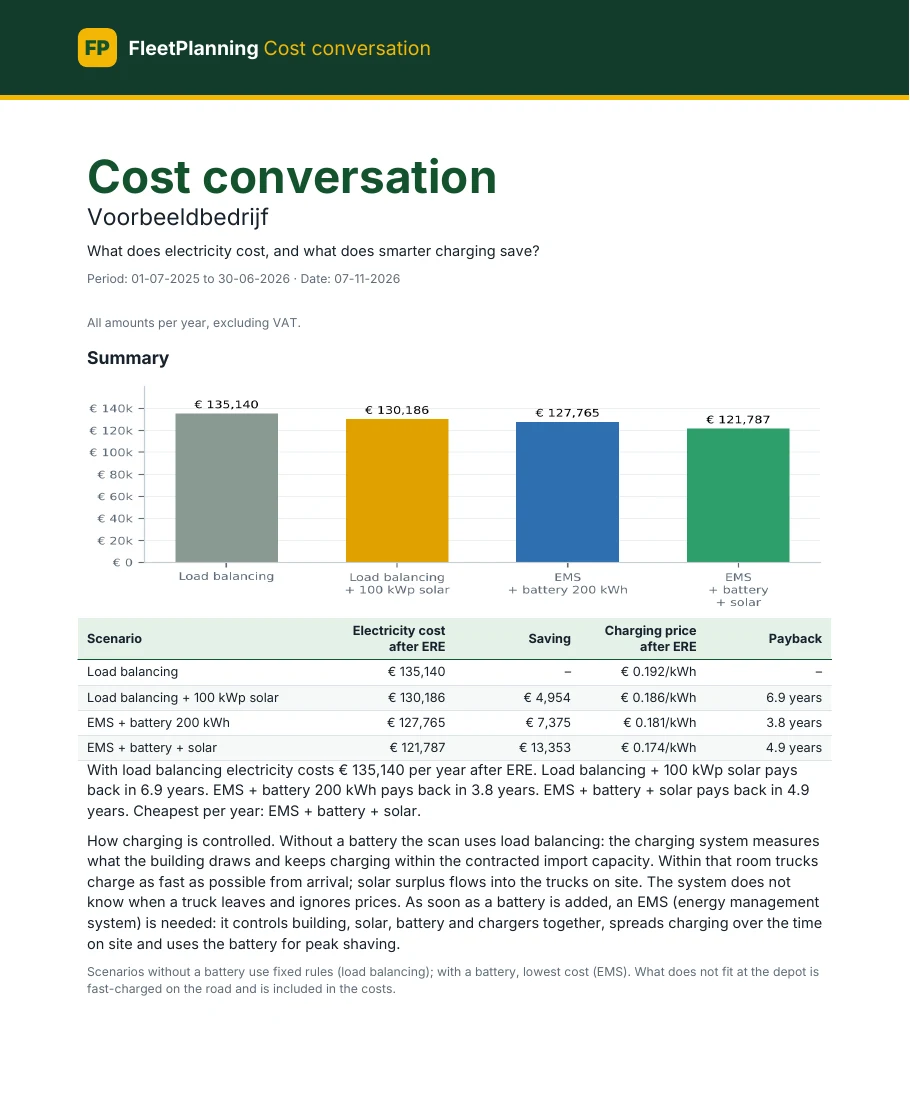
You get two conversations and two reports. The Energy conversation is about kWh and kW: does charging fit within your grid connection, how many more trucks fit and which contract do you need? The Cost conversation is about euros: what does electricity cost on your supplier and grid operator invoices, and what does a battery or extra solar save?
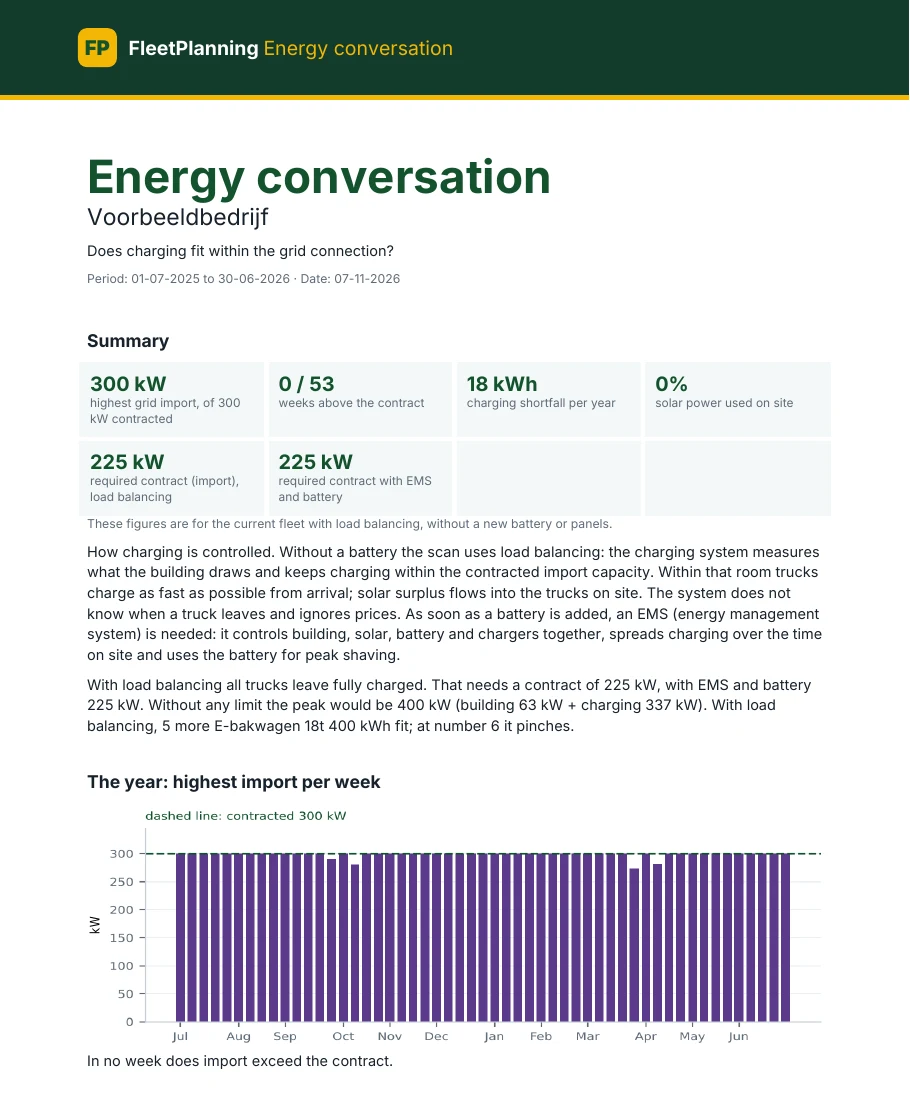
How to start: with the Energy conversation
Online
€ 650 excl. VAT
- Introductory call, online (one hour)
- I calculate all scenarios with your data
- We discuss the results, online (one hour)
- You receive the Energy conversation report and the Excel file
Next: the Cost conversation. Once you know what fits, we calculate what it costs: electricity on your supplier and grid operator invoices, and what a battery or extra solar saves. Same set-up and same price, without the introductory call: € 650 excl. VAT online, with a one-hour discussion.
We always calculate all scenarios, in both the energy and the cost conversation: the current situation with load balancing, with extra solar panels, with a battery (with EMS) and with battery and solar panels. The price covers one site with one meter. If a call takes longer than an hour, or there is other extra work such as more meters, I charge € 140 per hour excl. VAT. The FleetPlanning terms and conditions apply to all assignments.
What data is needed
- Electricity use of your connection over a year, as detailed as available: quarter-hourly, half-hourly or hourly data all work.
- Trips per vehicle: an export from your planning system (TMS) or fleet system with date, start and end time and distance. Driver names are not needed.
- Your fleet and which vehicles you want to replace.
- Grid connection and contract: contracted capacity, fixed or dynamic price.
- Optional: solar panels or the available roof space.
Metering data works differently in every country. This is where you can usually request it:
| Country | Usually available | Request from |
|---|---|---|
| Netherlands | quarter-hourly data | grid operator or metering company |
| Belgium | quarter-hourly data (digital meter) | grid operator, such as Fluvius, ORES or Sibelga |
| Germany | quarter-hourly load profile ("Lastgang") for larger consumers | grid operator or metering point operator |
| France | 30-minute data ("courbe de charge") | Enedis |
| United Kingdom | half-hourly data | energy supplier or network operator |
| Nordic countries | hourly or quarter-hourly data | national datahub or grid operator |
Not sure where to look? We'll figure it out together.
How it works
Introduction
One hour. We discuss your question, your fleet and your plans.
Share your data
You receive a personal link to an online form. There you fill in your data and upload metering data and trips. Paper is possible too. We agree on confidentiality.
Energy conversation
I calculate all scenarios and we discuss them in one hour: does charging fit, how many more trucks fit and which contract do you need? You keep the report and the Excel file.
Cost conversation
If you like, afterwards. One hour on what electricity costs and what a battery or extra solar saves, with the Cost conversation report.